
boxes for candle jars
Showing the single result
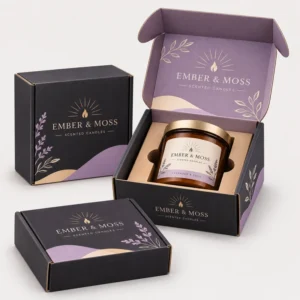
Well designed boxes for candle jars solve a specific packing problem, because a jar candle combines glass, weight, a lid and a label in a compact shape that must stay upright and still. A box that is too loose lets the jar knock against the sides, while a box that is too tight can scuff a label, lift a lid or crush a board edge. This guide explains how to size a jar box, choose inserts and board, plan print and test a packed jar, so makers and sellers can protect glass candles from pouring to delivery.
Why boxes for candle jars need a close and supported fit
A filled jar candle is heavier than its size suggests, and that weight sits low in the jar, which means the base of the box carries most of the load. If the base is weak or the jar can slide, the box may sag, the jar may tip, and the label may rub against the board. A close side fit, a firm base and an insert that cradles the jar prevent those problems, and they also improve presentation, because the jar sits centred when the box opens rather than leaning against one wall.
Jar shape adds another variable. Straight sided jars, tapered jars, jars with a wide mouth and jars with a wooden or metal lid each need a slightly different internal plan, even when their height and diameter look similar. A lid that overhangs the jar, for example, needs clearance at the top, while a tapered jar needs support at the base where it is widest. Testing with the real jar, including its lid, is therefore more reliable than ordering from a diameter measurement alone.
Common jar types and their box needs
Amber glass jars suit a natural, apothecary style brand and need a box that protects glass while letting the label and scent name stand out. Clear glass jars show the wax colour, so the box should protect the glass without hiding the candle entirely on a retail shelf, which may argue for a window or for a box that opens to reveal the jar fully. Ceramic jars are heavier and less fragile than glass, but they still need a firm base and a close fit to prevent chipping at the rim. Small votive jars sold in multiples need a tray or divider that keeps each jar separate.
Measuring a jar candle correctly for a box
Measure height with the lid fitted, diameter at the widest point, and weight when filled, and note the lid material and any overhang. Add a small margin for an insert or protective wrap, but keep that margin small, because a finger width of movement on each side is enough for a jar to shift in transit. Record those measurements with the jar name or size, such as a 30cl jar, so a repeat box order can be matched to the same vessel without remeasuring.
Board, inserts and closures for jar candle boxes
Board choice should follow the journey, not only the shelf. A folding card box suits retail display and hand delivery, while corrugated board suits posting, because it resists drops, stacking and corner impacts. For a premium jar range, rigid board gives a substantial feel and holds its shape after repeated opening, but it needs more storage space and a higher order commitment. In every case, the base should be strong enough to support the filled jar without bending, and the closure should stay shut during handling.
Inserts are the most useful addition for jar candles. A card insert can cradle the base and hold the jar upright, a corrugated insert can separate multiple jars, and a honeycomb style paper sleeve can cushion a single jar inside an outer box for posting. The insert should be tested at packing speed, because an insert that is fiddly to fit will slow packing and may be skipped by busy staff. A simple insert that works every time is better than a complex insert that works only in a sample.
Closures that keep a jar box shut and easy to open
Tuck end closures suit most retail jar boxes, because they close cleanly and can be sealed with a small label. Lid and base boxes suit gift jars, because they lift off fully and reveal the jar at once, and they also suit jars with a tall lid that needs clearance. For posting, a tuck end box inside a protective outer mailer gives two layers of protection, with the inner box handling presentation and the outer mailer handling transit. Check that the closure does not press on the lid, because pressure on a wooden lid can mark it or lift it slightly.
Print, labels and safety wording on jar boxes
Print on a jar box should make the scent name, brand and care wording easy to find, without covering the jar label when the box is open. Keep scent names legible from a short distance, keep safety wording clear, and leave space for a batch code if the maker uses one. A window can show the jar, but it creates a weak point and may need clear film, so decide whether shelf display or transit protection matters more for that range. For the wider candle range, see box packaging for candles, and for bulk planning see boxed candles wholesale.
Posting jar candles and testing a packed box
Posting a jar candle is the hardest test for its box, because a parcel may be dropped, stacked and handled many times. Pack the jar in its box with the insert, place that box in an outer mailer or carton with a close fit, and test the full parcel by lifting, shaking gently and stacking it as a courier might. Check the jar, lid and label after the test, and look for scuffs, movement or board damage. A test parcel sent to a colleague, opened and photographed on arrival, gives a realistic check before a large order.
Storage also affects jar boxes. Keep flat packed boxes in a dry place, away from heat that could soften wax if candles are stored nearby, and keep made up rigid boxes protected from dust and crushing. Label stored boxes by jar size and scent, so staff do not need to open several boxes to find the right one. That simple habit reduces handling, which in turn reduces the chance of a jar being knocked before it is even packed.
Ordering jar candle boxes for a growing range
When a range includes several jar sizes, decide whether each size needs its own box or whether an adjustable insert can serve two close sizes. Sharing a box structure across sizes can simplify ordering, but only if the fit remains close for the smaller jar. Share vessel dimensions, lid details, insert needs, print coverage and sales route when requesting a quote, and raise any seasonal or gift variation early, so the structure can carry different print without a new design each time.
Next steps for a jar candle box quote
When jar measurements, insert need and print coverage are clear, use request a quote for custom boxes and read learn about Personalized Mailer Boxes for supplier background. After final artwork approval, standard lead times are 10 to 14 working days, corrugated lead times are 12 to 15 working days, and rigid or specialist lead times are 13 to 16 working days, stated as production times rather than a guaranteed delivery date.
Frequently asked questions
1. What size box do I need for a 30cl candle jar? Measure height with the lid fitted and diameter at the widest point, add a small margin for an insert or wrap, and test the packed jar before ordering, because lid shape and jar taper affect the fit.
2. Do jar candle boxes need an insert? An insert is strongly recommended for glass jars, especially for posting, because it holds the jar upright, stops sliding and protects the base and label from rubbing against the board.
3. Can jar candle boxes be printed? Yes, print can carry the brand, scent name, care instructions and safety wording, provided text stays legible and does not sit across a fold or glue area.
4. How should I post a jar candle safely? Place the jar in a close fitting box with an insert, then place that box in a protective outer mailer with a close fit, and test the full parcel before sending a large number of orders.
5. How long does production take for jar candle boxes? After final artwork approval, standard production is 10 to 14 working days, corrugated production is 12 to 15 working days, and rigid or specialist production is 13 to 16 working days.