
custom book boxes
Showing the single result
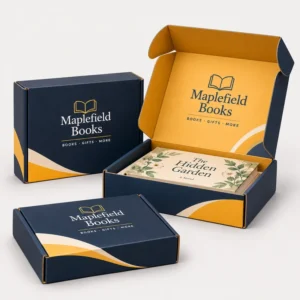
Custom book boxes are packaging boxes made to the size, board and print specification of the books they will carry. They protect corners, spines and covers far better than a loosely fitting carton, because a book that cannot move inside its box cannot scuff, dent or bend in transit. For publishers, bookshops, authors and subscription sellers, a well fitted book box also presents an order as a finished product rather than a parcel that happens to contain a book.
Why custom book boxes protect books better
Most book damage in transit comes from movement, not from a single heavy impact. A book that slides forward can strike the end of a carton and crush a corner. A book that sits at an angle can bend a cover along a fold. A stack of books with no divider can rub covers together and wear print from a spine. A box made to the book removes those risks at the source. The internal length, width and depth match the closed book, with just enough clearance to pack and unpack the book without force. That simple discipline does more for condition than extra layers of loose filler, which can shift and press unevenly against a cover.
Board choice adds a second layer of protection. Corrugated board absorbs knocks and suits books that will travel by post or courier. Solid card gives a cleaner, lighter mailer for paperbacks and slim volumes. Rigid board gives a firm, premium shell for signed editions, art books and collector titles. The right board depends on the weight of the book, the distance it will travel and whether the box is meant to be kept, reused or recycled after delivery. A heavy art book needs a different structure from a slim paperback, even if both are described in general terms as books.
Fitting paperbacks, hardcovers and oversized titles
Paperbacks need a snug, light mailer that stops the book bending in a mail sack or a postbag. A book wrap style mailer that folds tightly around the book works well here, because it leaves almost no void for movement. Hardcovers need stronger corners and a firmer base, because their cover boards can dent and their spines can split if a corner takes a blow. Oversized titles, such as atlases, photography books and cookbooks, need a wider base and a board that will not bow under weight. Measuring the book closed, including cover boards and any dust jacket, gives the only reliable starting point for all three formats.
Measuring a book for a fitted box
Measure height from the top edge to the bottom edge, width from the spine to the fore edge, and thickness at the spine where the book is widest. Add any insert, bookmark, letter or signed card to the thickness before ordering, because an extra few millimetres can turn a perfect fit into a box that will not close cleanly. If you sell the same title in paperback and hardcover, order a size for each format rather than forcing both into one compromise box. Readers notice the difference, and returns for damaged corners fall when each format has its own fit.
Who uses custom book boxes every day
Independent publishers use book boxes for direct orders, review copies and launch mailings where condition and presentation both matter. Bookshops use them for online orders, click and collect packing and signed stock that must arrive flawless. Authors use them for crowdfunded editions, signed copies and event stock. Subscription sellers use them for monthly titles where the box itself becomes part of the ritual of opening. Schools, libraries and training providers use them for sets of textbooks and course readers that must survive repeated handling. Each buyer has a different priority, but all of them benefit from a box that fits the book rather than a box that merely contains it.
Choosing print, material and finish for custom book boxes
Print turns a protective box into a brand asset. An outside print can carry a logo, a series identity or a simple, confident title. An inside print can carry a thank you message, a reading guide or a pattern that surprises the reader on opening. Full artwork suits a launch or a special edition, while a single colour logo suits a regular order box that must stay recognisable without dominating the book itself. Artwork should be checked at actual size, with titles and logos kept clear of folds, flaps and tape areas where print can crack or disappear under sealing.
Material and finish should follow the life of the box after delivery. Kraft board suits a natural, bookish look and recycles readily. White board gives brighter colour reproduction for illustrated covers and bold branding. Matte lamination gives a soft feel and reduces scuffing in handling. Gloss lamination gives colour extra depth and suits photographic artwork. A restrained finish usually ages better on a shelf than a busy one, and it keeps attention on the book that the reader actually bought. Explore related presentation options in custom book style boxes for gifts and keepsakes.
Sustainable choices that still protect the book
Many buyers now ask how a book box is made and what happens to it after use. Recycled board, uncoated kraft and water based inks can all reduce impact without weakening protection, provided the board grade is chosen for the weight of the book. A lighter board may suit a paperback, but it will not protect a heavy hardcover through a long courier journey. The sustainable choice is therefore not simply the lightest box, but the lightest box that still protects the book on its actual journey. A damaged book that must be replaced and reposted creates far more waste than a slightly stronger box used once and recycled well.
Reducing void fill without risking damage
A fitted book box often needs little or no void fill, which simplifies packing and improves the unboxing experience. Where a small gap remains, a single fitted card divider or a flat sheet of protective paper is usually better than loose filler that can migrate to one end of the box. Packing teams work faster with a fitted box, because they do not need to judge how much filler each order requires. Consistency in packing also means consistency in condition on arrival, which is exactly what repeat book buyers remember.
Ordering and delivery for custom book boxes
A clear quote starts with format, quantity, board, print and finish. State whether the box is for a single title or a range of titles, and whether artwork will be printed inside, outside or on both surfaces. If quantities vary by title, say so early, because a shared size across titles can sometimes reduce cost without harming fit, while a forced shared size across very different formats can harm it. Samples and proofs are worth their time for a new title, especially for a hardcover where a millimetre of clearance changes how the book feels in the hand.
Lead times after final artwork approval are 10 to 14 working days for standard boxes, 12 to 15 working days for corrugated boxes and 13 to 16 working days for rigid or specialist boxes. Plan a launch, a subscription send or a signing event around those times, with room for proof approval and packing. Full details are on the delivery information page. To begin, request a quote for custom book boxes or browse the full shop for packaging ranges. Before posting, check the Royal Mail parcel postbox guidance for drop off size limits.
Frequently asked questions about custom book boxes
Question: What are custom book boxes?
Answer: They are boxes made to a specific book size, board and print specification, so the book fits snugly, stays protected in transit and arrives looking like a finished product.
Question: Do I need a different box for paperback and hardcover?
Answer: In most cases yes, because hardcovers are thicker, heavier and more vulnerable at the corners. A separate size for each format gives a better fit and fewer damaged arrivals.
Question: Can custom book boxes be printed inside and outside?
Answer: Yes. Outside print builds recognition on delivery, while inside print can carry a message, a pattern or a reading guide that the reader discovers on opening.
Question: Are custom book boxes recyclable?
Answer: Card and corrugated book boxes are widely recyclable, provided any tape, labels and inserts are removed as advised by local recycling guidance and the board grade suits recycling.
Question: How long does production take after artwork approval?
Answer: Standard boxes take 10 to 14 working days, corrugated boxes take 12 to 15 working days and rigid or specialist boxes take 13 to 16 working days after final artwork approval.