
votive candle packaging boxes
Showing the single result
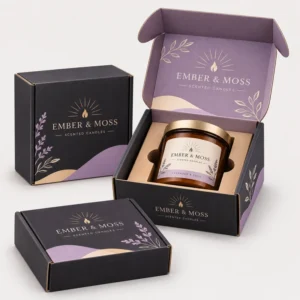
For makers and retailers packing small candles, votive candle packaging boxes are the boxes used to pack, present and post them, whether as single candles, pairs or sets. They protect glass holders and wax finishes, keep candles upright and separated, and give a finished look that suits a shop shelf, a market stall or an online order. The right box depends on how many candles it holds, how it will be sold, and how far it will travel.
How votive candle packaging boxes work across a range
A maker who sells one scent in a single votive needs a different box from a retailer who sells a set of six votives as a gift. Single boxes focus on fit and presentation for one candle. Pair boxes need a divider or a shaped insert so the candles do not knock together. Set boxes need a layout that keeps every candle visible and secure, while still closing cleanly and stacking well.
Single, pair and set boxes compared
Single boxes are the simplest to pack and the easiest to adapt across scents, because only the print or label needs to change. Pair boxes suit gifts and trial sets, and they work best with a divider that keeps the candles apart. Set boxes can be arranged in a row or a grid, and they benefit from an insert that holds each candle in its own position. For sets, test the full box, not just one candle, because weight and balance change once every position is filled.
Dividers and inserts for multiple candles
Dividers prevent glass holders from touching, which reduces chipping and marking. Inserts with individual positions also make packing faster, because each candle has an obvious place. If a set box will be posted, choose an insert that holds candles firmly enough that they do not lift out when the box is turned over.
Materials that suit candle makers
Folding boxboard is a popular choice for votive packaging boxes because it prints cleanly and folds into neat, retail ready shapes. Kraft board suits natural, handmade and botanical ranges, and it pairs well with simple, earthy print. White board suits bright artwork, detailed illustration and photography. For heavier sets, a stronger board or a rigid box may be needed to support the total weight without sagging.
Matching board to the sales channel
Shop stock can use lighter board if boxes will be handled gently and displayed on a shelf. Postal stock needs stronger board and a secure closure, because the box will be handled, stacked and possibly placed inside an outer parcel. If the same box serves both channels, specify it for the tougher postal use.
Sizing and packing votive candle packaging boxes
Good sizing starts with accurate measurements of the candle and its holder. Measure diameter, height and weight, and note any lid, label or decoration that changes the shape. Then decide whether an insert or divider will be used, and test the complete pack with real candles. A box that fits an empty holder may not fit a finished candle with a label and a lid.
A practical sizing routine for makers
Start with the largest candle in the range, because a box sized for the smallest candle may not suit the rest. Pack the largest candle, add the insert, close the box, and check that it closes without forcing and that the candle does not rattle. Repeat the test with the smallest candle in the range if one box will cover several sizes, and decide whether a single box truly suits the whole range or whether two sizes would work better.
Common sizing errors to avoid
The most common error is measuring wax alone and forgetting the holder. Another is allowing room for a label that wraps around the holder and adds width. A third is choosing a box that is tall enough but too narrow, so the candle can be inserted only at an angle. Each error is easy to catch with a real candle test before ordering.
Posting votive candles safely
For postal orders, the votive box is often placed inside an outer parcel box with protective material around it. That outer layer protects the retail box and the candle from impact and moisture. Keep the retail box closed and secure inside the outer box, fill any large gaps so the inner box cannot move freely, and label the outer parcel clearly. If several votive boxes share one outer parcel, keep them upright and separated so glass holders do not knock together.
Protecting glass holders in transit
Glass holders need protection from both impact and pressure. An insert inside the votive box, plus protective material in the outer parcel, gives two layers of protection. Avoid packing glass holders tightly against a hard outer wall without any cushioning between them.
Print, branding and retail presentation
Print helps customers recognise a scent, a maker and a range. A consistent system across single, pair and set boxes makes a range look professional on a shelf and online. Use the same scent naming, the same colour cues and the same placement of safety information across the range, so customers can move from a single candle to a set without confusion.
Designing for a shelf and a screen
A box that looks good on a shelf also needs to look good in a small online photograph. Keep the scent name large and legible, avoid clutter on the front panel, and use a colour or pattern that reads clearly at a small size. If the box has a window, make sure the candle colour shown through the window matches the scent it represents, so customers are not misled.
Safety information and legibility
Safety information should be easy to read and placed where it will not be covered by a sticker, a seal or a fold. Check legibility on the chosen board and print finish, because small text on a textured kraft board can be harder to read than the same text on smooth white board. If in doubt, increase the text size or simplify the layout.
Ordering, lead times and samples
Custom packaging boxes need time for artwork approval and production, so plan orders around product launches, markets and seasonal gifting periods. Standard lead times after final artwork approval are 10 to 14 working days, corrugated lead times are 12 to 15 working days, and rigid or specialist lead times are 13 to 16 working days. These are planning guides, not a guaranteed delivery date. You can request a quote for custom packaging once sizes, quantities and print details are clear, and check the delivery information for custom orders. You can also learn more about Personalized Mailer Boxes and browse the full shop range.
Sample checks before a full run
Order samples for single, pair and set boxes, pack each with real candles, and check fit, closure, print and stacking together. A sample set reveals problems that a single sample may hide, such as a divider that works for one candle but not for a full set.
Frequently asked questions about votive candle packaging boxes
Can one box suit all my votive candles?
Only if your candles share a similar size and holder. If sizes vary widely, two box sizes will usually give a better fit and a more professional result than one compromised size.
Do set boxes need dividers?
Dividers are strongly recommended for sets, especially where glass holders are used. They prevent knocking, keep candles upright and make packing faster and more consistent.
What board is best for votive candle boxes?
Folding boxboard suits most retail votive boxes. Kraft board suits natural ranges, white board suits bright artwork, and stronger board suits heavier sets and postal use.
How should I post votive candles?
Pack the candle in its retail box, then place that box inside an outer parcel box with protective material around it. Keep candles upright and separated, and label the outer parcel clearly.
Should safety information be printed on the box?
Yes, safety information should be legible and placed where it will remain visible once the box is assembled, sealed and labelled. Check it on a physical sample.